Capabilities and executable examples
trade-study orchestrates domain-supplied simulators and scorers. Its core
requires only NumPy. Optional libraries provide designs, Pareto algorithms,
scoring, optimization and plotting; statistical estimators belong to the caller.
Choose a public interface
| Task | Implemented interface | Dependency and boundary |
|---|---|---|
| Declare factors and objectives | Factor, FactorType, Observable, Direction, Constraint |
Core; bounds and feasibility are caller-defined. |
| Construct designs or screen factors | build_grid, FactorConstraint, screen, sobol_indices |
Full discrete factorial is core; sampled designs/sensitivity need design. |
| Evaluate a fixed replicated grid | run_grid, ResultsTable.aggregate_replicates |
Core; optional parallel for workers. Supply generate(..., rep=...) to vary randomness. |
| Submit frozen Python tasks | slurm.freeze_checkout, prepare_slurm_plan, SlurmTask |
Experimental Slurm launch layer; Git/POSIX/shared environment, checked source/imports and task receipts. Runner integration remains explicit. |
| Compare paired designs | paired_difference, paired_rank |
Core bootstrap; t intervals need SciPy. Nonfinite pairs are excluded and n_pairs is reported. |
| Allocate replication | run_sequential, ReplicationPolicy |
Fixed or adaptive policy with recorded bounds, counts and assumptions; power is not automatically certified. |
| Plan fixed proportion precision | proportion_interval, replicates_for_half_width |
Proportions guide; Wilson precision is not a power calculation or sequential interval. |
| Select nondominated alternatives | extract_front, pareto_rank, hypervolume, igd_plus |
pareto; positive objective scaling preserves front membership. |
| Report decisions across preferences | preference_sweep, PreferencePolicy |
Regret, practical equivalence and optional paired uncertainty; preferences are specified by the caller. |
| Chain study phases | Study, Phase, phase filters |
Requirements follow each chosen filter/runner; preserve reproducibility between phases. |
| Optimize or allocate fidelity | run_adaptive, AdaptiveSession, run_successive_halving, run_hyperband |
adaptive for Optuna; persistent sessions retain their declared objective/constraint contract. |
| Fit response models with validation diagnostics | fit_surrogate, fit_regime_surrogate, sensitivity_from_table |
surrogate plus optional design; inspect grouped validation and support diagnostics. |
| Score and combine predictions | score, coverage_curve, stack_scores, stack_proportional, stack_bayesian, ensemble_predict |
NumPy core selects score weights and combines predictions; scoring/Bayesian integrations use their extras. See weight contracts. |
| Cache, resume and publish results | EvaluationCache, grid checkpoints, save_result_bundle, load_result_bundle, publish_result_bundle |
Core; bundles require independently supplied expected provenance for guarded reuse. |
| Export or plot | ResultsTable.to_dataframe, plotting helpers |
dataframe or viz. |
The API reference contains the detailed signatures. op_infer composes these
runners with calibration and inference callbacks; trade-study supplies no
posterior sampler or model likelihood. Slurm remains the external scheduler;
the optional launch layer runs explicitly declared Python tasks.
A complete replicated study
The README quickstart and
examples/replicated_study.py
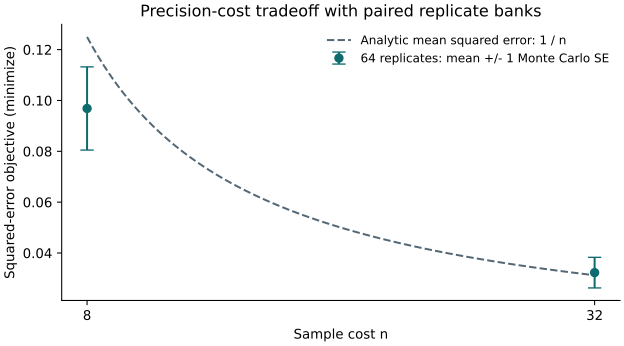
compare sample means using 8 versus 32 observations. A fixed bank of 64 independent
replicates shares nested sample banks across designs. Costs are exactly 8 and 32;
errors are compared by replicate before aggregation and Pareto extraction.
| Samples / cost | Replicates | Mean squared error | Monte Carlo SE | Analytic mean (1 / n) |
|---|---|---|---|---|
| 8 | 64 | 0.09685 | 0.01636 | 0.12500 |
| 32 | 64 | 0.03229 | 0.00602 | 0.03125 |
Paired mean difference (32 minus 8): -0.06456, using 64 finite pairs. Analytic expected difference: -0.09375.
For independent standard-normal observations, the sample mean's expected
squared error is 1 / n. The finite bank's empirical mean varies around this
reference. The error bars show one estimated Monte Carlo standard error of
each mean, rather than a confidence level or a calibration verdict. Both
sampled designs are nondominated for the observed error and exact cost; the
paired contrast retains the 64 shared replicate identities.
Download the vector PDF. The checked table is included directly from the generated artifact:
uv run --python 3.12 --extra dev --with matplotlib==3.11.2 python examples/illustrate_replicated_study.py
just figures-check
The check reruns the actual study, compares the complete plotted data and table, and validates source/export fingerprints. It needs the Pareto extra but no plotting dependency. Regeneration also saves the plotted data.
The example is a precision/error-cost demonstration. It supplies no calibration or power certification. Declare failure handling before choosing a success-only paired comparison; bootstrap resamples are not additional independent cohorts.
For larger workflows use the CSTR, sklearn, assay, serosurvey, monitoring and Bayesian criticism guides. The serosurvey notebook combines context grids, sampling frames, paired comparisons, decisions and result bundles.
What runs automatically
Default pytest and CI now collect source docstrings as well as tests. Public
examples cover grids/constraints, aggregation, Wilson precision, Pareto sorting,
scoring layouts and ensemble prediction. just doctest also executes the actual README and
standalone replicated study and checks their agreement and known costs. CI runs
the larger CSTR/sklearn/assay workflows and serosurvey scripts/notebook separately.
Monitoring and Bayesian figure-generation scripts run in a scratch directory,
with a known-answer energy-score regression test for the Bayesian scorer.
Maintain complete executable entry points and independently check a known
quantity or invariant. Optional examples must declare their extra and run in a
job that requires it; skipped optional tests are not qualification evidence.
Run just ci before every commit, just build-all for wheel validation, and
uv run mkdocs build --strict for documentation changes.